


I have been fairly critical of auto history YouTube channels, so I thought I would acknowledge what seemed to be a fairly good analysis of the 1953 Studebaker “Loewy coupes.” The King of Classic Cars (2025) just came out with a video that applauds the car’s iconic styling but focused on issues that they thought contributed to Studebaker’s declining sales, such as a weak frame, sloppy assembly and some other mechanical gremlins.
That’s a promising approach, but the more I listened, the more it struck me that the arc of its narrative had remarkable similarities to a video posted a few months ago on Adam Wade’s (2025) channel, Rare Classic Cars & Automotive History.
Both discuss Studebaker’s postwar focus on styling leadership and the role of design consultant Raymond Loewy. Both name checked the talented crew that Loewy assembled to come up with the 1953 coupes, which started out as a show car. And both videos noted that the car, despite its exceptional styling, suffered from flaws — although the King went into more details than Wade.
The King has difficulties with sales data
I could also quibble with a few factual items, such as the King of Classic Cars (2025) stating that “for several years, the company regularly ranked fourth in U.S. auto sales, right behind Chevrolet, Ford and occasionally Plymouth or Buick.”
The following graph was shown while the narrator made the above statement.

I have no idea what the above graph is supposed to represent. In addition, where does the King gets the idea that Studebaker ever ranked Number 4 in sales during the postwar period?
For example, Studebaker’s peak year was 1950, when output almost reached 321,000 units. That was only good for eighth place — and well behind Plymouth, which produced roughly 611,000 units, Ford 1.21 million and Chevrolet 1.23 million.

The King copied what Wade said — with less context
I suspect that the King pulled content directly from Wade (2025), who stated that Studebaker “was America’s best-selling independent automaker all the way through till 1957 and it often placed fourth in sales behind the divisions of Detroit’s Big Three — Chevrolet, Ford, sometimes Plymouth or Buick.”
There is some truth to the first part of Wade’s statement. From 1950-53 Studebaker had the highest production levels of any independent automaker. However, Nash/Rambler passed Studebaker in 1954 and would do so again in 1956.

Perhaps from 1955 onward Wade (2025) added together the output of the newly formed Studebaker-Packard and compared it to the also new Nash-Hudson combine called American Motors. It is true that S-P’s production was higher than AMC’s in 1955-56, but what about 1954? At least according to the data I have access to, Studebaker’s record was more mixed than Wade presented.
The King echoes Wade on the car’s wheelbase
Another area where the King may have pulled content from Wade was suggesting that an important decision was for designer Robert Bourke to propose that the Loewy coupes be put on the 120.5-inch wheelbase of the Land Cruiser rather than the 116.5-inch wheelbase of the Champion and Commander family cars.
“This decision dramatically improved the car’s proportions,” the King of Classic Cars (2025) stated, “resulting in sleeker lines and and a more balanced cabin [by] placing the rear seats ahead of the axle instead of directly over it.”
Let’s compare this narrative to what Wade (2025) said: “Bourke made a few changes. Namely, that he wanted to employ the Studebaker Land Cruiser’s longer 120.5-inch wheelbase versus the regular Studebaker’s 116.5-inch frame. This really helped the car overall from a proportion standpoint, and it enabled the back seat to be placed ahead of the rear axle instead of over it.”

Was a longer wheelbase really better?
I would question the idea that putting the Loewy coupes on the longer wheelbase was a good decision. Although that presumably increased back-seat room, it did so to the detriment of the car’s proportions.
The problem was that the Studebaker body was compact in its width (only 71 inches) but almost 202 inches in length. At least to my eyes, that gave the car an overly long, cigar-shaped quality for a sporty coupe.
This is why using the 116.5-inch wheelbase would have been at least a partial improvement — as long as the four inches were taken from behind the B-pillar rather than in front of the cowl. To see what I mean, below you will find a “real” Studebaker Commander Starliner hardtop followed by a fake one.


Is copying content the trendy thing to do?
Now that I have shared with you my biggest stylistic beef with the Loewy coupes, let’s return to the question of why the two videos are so similar. Wade’s content was posted more than two months before the King’s, so the latter producers had the opportunity to draw from it.
Also see ‘Do vloggers represent the future of automotive history?’
I will leave it for others with more specialized legal knowledge to argue over whether the King of Classic Cars has engaged in copyright infringement. At the very least the production team could improve its research and writing skills so they aren’t just rehashing someone else’s analysis. Like how about double checking facts to make sure that you aren’t repeating an error?

NOTES:
Production figures were calculated with data drawn from the auto editors of Consumer Guide (1993), Gunnell, (2002) and Wikipedia (2020).
Share your reactions to this post with a comment below or a note to the editor.
RE:SOURCES

- Auto editors of Consumer Guide; 1993, 2006. Encyclopedia of American Cars. Publications International, Lincolnwood, IL.
- Flory, J. “Kelly” Jr.; 2009. American Cars, 1946-1959: Every Model, Year by Year. McFarland & Co.
- Gunnell, John; 2002. Standard Catalog of American Cars, 1946-1975. Revised Fourth Ed. Krause Publications, Iola, WI.
- King of Classic Cars; 2025. “The Stunning 1953 Studebaker That Killed Its Own Brand.” Posted July 28.
- Wade, Adam; 2025. “Most Beautiful (& Flawed) Cars: 1953 Studebaker Coupes Had Only Skin-Deep Beauty.” Rare Classic Cars & Automotive History. Posted May 18.
- Wikipedia; 2020. “U.S. Automobile Production Figures.” Accessed March 28 (content no longer online).
ADVERTISING & BROCHURES:
- ads.aacalibrary.org (Antique Automobile Club of America): Studebaker (1953)
- oldcaradvertising.com: Studebaker Avanti (1963); Studebaker Champion (1950)



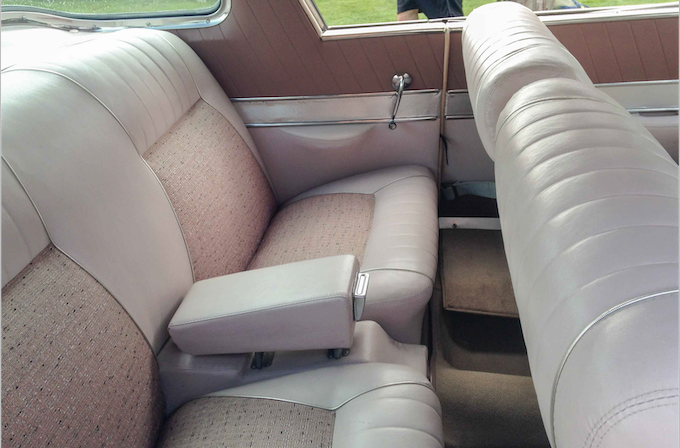
As near as I can tell the rear seatback top is about an inch or so behind the C pillar, and the seatback rake is roughly parallel to the C pillar. Even on the short WB one this puts the seatback a foot or so in front of the rear axle. I checked the ad painting with photos and the painting looks pretty accurate, something you couldn’t depend on in those days.
For what it’s worth, here’s a photo of the back seat of a 1956 Hawk. The Lark was a fairly easy project because the basic Studebaker body, which dated back to 1953, had so much length to prune.
The King of Classic Cars video was new to me. Thanks for calling it to our attention. But it is overly critical and you’d think the reliability of a ’53 Stude was worse than a warranty-less Yugo! Pure hogwash.
All of the mechanical systems – engine, suspension, electrical, steering, brakes – were lifted from proven and reliable models of previous years. Yes, the body was new and the frame modified slightly from previous practice.
The production fiasco was caused, as l understand it, by inadequate pre-testing of the assembly process and the flexing of the “new” frame, in V8 models of the coupes and hardtops. When front clip attachment was first attempted on the line, the sheet metal wouldn’t fit! Yikes! Back to the drawing board as they say.
It took a few frantic weeks to fix. Additionally, the still large and unprecedented demand for the “Loewy Coupes” naturally meant a cranking up of the line speed, which naturally meant a drop in quality control. Maladies like these often plagued even the best of manufacturers.
No need to beat this to death as does the King Classic video. Buick in ’55, Packard in’55, Chrysler in ’57, GM at various times (and causes), rusty Fords, AMC too – seemingly nobody was guiltless in having production/quality problems. Even Ford recall stats today are concerning.
But the 1953 Studebaker “coupes” were, in the end, beautiful machines that gave reliable service and pride of ownership to thousands of customers. The King Classic Car video loses sight of this fact and spends way too much time playing up any bad news about these timeless cars. That sours the video for me.
I take it that you disagree with Bonsall’s Studebaker history, where he calls the 1953 Studebaker product program was “one of the worst conceived and executed in the history of the industry. . . .” (p. 7).
It’s true that “nobody was guiltless” when it came to quality lapses in the 1950s. However, we should acknowledge that when major problems became apparent to the public that they tended to subsequently steer clear of that automaker for a while. I would suggest that Packard’s sales collapse in 1956 was partly a reaction to the quality issues with 1955 models. The same could be said of the Chrysler Corporation’s weak sales in 1958.
Think about it this way: If I am a regular Joe who spent good money on a 1953 Studebaker and my car had major problems, would I care all that much whether the automaker had subsequently fixed them if I am stuck with a turkey? Even back then, buying a new car was a major purchase, so I might very well be less inclined to risk buying a Studebaker next time — and might tell my friends about my bad experience.
Look at the sales figures for Studebaker versus Nash in 1954. Even though in previous years Studebaker had stayed consistently ahead of Nash, for 1954 they traded places — despite Studebaker fielding newer entries. By all rights the Loewy coupes should have sold better in 1954, but I suspect that they didn’t primarily because of quality concerns.
About your shortened version: Doesn’t look bad, of course. But the longer wheelbase makes the trunk a little more useful (we used to cart our very young son to meets and a folding playpen would just make it inside the trunk) and the back seat a little more comfortable. I spent lots of time back there as a kid in my dad’s Hawk. We even hauled our family and my grandparents in our Hawk for a 200 mile trip, something tough to do with a rear shortened to Mustang dimensions.
Studebaker advertised the coupes, with kids and mothers present in an magazine ad picture, as being capable “family sports cars”. Mustangs not so much. 1953 was not 1964 and the appeal and pitch had to be different. Then again, Studebaker coupes were 20 years ahead of their time if you look at products for the personal car era. Interesting.