


In 2024 Indie Auto’s readership more than doubled. Although we are still very much a small fry compared to the leading for-profit auto history websites, we have grown far more than I ever expected.
Indie Auto’s donor ranks also grew in 2024. This reflects a mix of return donors and new ones. I don’t currently have a way to give donors “premiums” — all I can offer is a public thank you for your contribution.
However, as discussed in a minute, a major goal of 2025 is to shift to a new platform that works better for a reader-supported website. But first let’s discuss why Indie Auto turned out the way it has.

Indie Auto is different . . . by design
Frankly, I didn’t know if there would be much interest in Indie Auto when I first began building it in the spring of 2012. My goal was to offer the opposite of what I most disliked about the auto history media. Although the rise of the internet has vastly increased the amount of easily available content, it struck me as being increasingly dumbed down by clickbait, car porn and barstool philosophizing.
This trend has arguably been heavily driven by the business model chosen by almost all auto history websites, which have relied mostly, if not, entirely on advertising revenue. The pressure to generate a 24/7 flow of engaging content tends to privilege quantity over quality and virality over nuance.
Also see ‘Wheel spinning happens when car buffs and scholars don’t collaborate’
To make matters worse, media trends have leaked into the automotive book-publishing business, which has increasingly emphasized glossy pictures and pom-pom waving over substantive analysis.
I didn’t expect to reverse these trends, but I did intend to criticize them — through serious commentaries as well as satirical ads. A few (former?) readers have found the ads unacceptably silly, but they reflect the heart of the website. Instead of selling your eyeballs to advertisers, we make fun of a business model that all too often has dumbed down American automotive history.

Indie Auto has mostly grown from search-engine traffic
Indie Auto isn’t governed by a 501c3 organization (so donations aren’t tax deductible). Even so, I run the website as a not-for-profit endeavor that attempts to help build the capacity of the auto history media. This is why I place so much emphasis on linking to other websites and social media.
Despite those efforts, Indie Auto has generated few referrals from other auto history websites aside from much-appreciated mentions by Daniel Strohl during his lengthy tenure at Hemmings. We have mostly grown from Google searches.
Also see ‘Daniel Strohl leaves a big hole in American automotive history media’
Another way that we have become more widely known within the auto history media has been when commentators such as Stéphane Dumas have posted links at other websites. I have always appreciated those efforts.
We also have gained new readers when Facebook pages and email distribution lists have linked to Indie Auto stories. This has resulted in readership patterns that I would not have predicted. For example, our four most-popular articles have been (in order) about the 1976 AMC Pacer, the 1978 Cadillac Eldorado, Mitsubishi in the U.S., and the 1963 Mercury Marauder. Readership spikes have often been followed by waves of complaints.

Indie Auto has arguably outgrown its clothes
Before I retired in 2018, Indie Auto was a weekend-warrior project — something I did on a casual basis. After that point I tried to treat it as a professional activity by upgrading the website and publishing regularly. First I set up a monthly posting schedule but more recently shifted to multiple times per week.
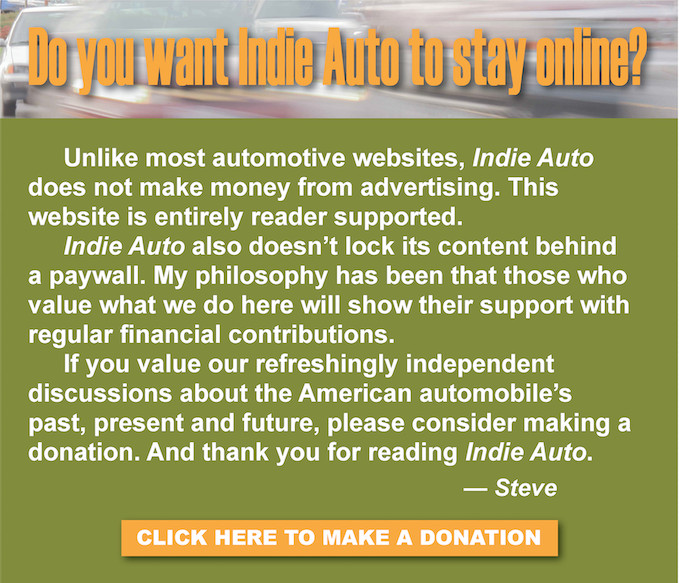
I also began to solicit donations, although a paywall wasn’t added. Instead, Indie Auto has operated on an honor system. This has been enough to cover basic hard costs but not enough to be sustainable over the long run. And now that I am living on a fixed income I am less able to subsidize those costs.
Also see ‘What software would you use if you were launching an automotive website?’
In addition, our mechanism for accepting donations is rather rudimentary for a reader-supported publication. Adding the right features to the current website would increase ongoing costs so much that it violates my sense of frugality, so I have been experimenting with alternative platforms.
To speed the transition to a new website I have been posting at least five times per week. This helps me do the considerable amount of reformatting that is necessary in making a switch.

What will the new website be like?
Substack appears to be the best alternative platform. However, there are enough issues to work through that I am not ready to announce a switchover date.
What I can say is that it is NOT my intention to put Indie Auto behind a full paywall. You will still be able to read most content free of charge. In addition, discounts and complimentary subscriptions will be available to those who find the subscription price of $5 per month or $50 per year too steep. Unfortunately, these are the minimum amounts Substack allows as a regular subscription.
I will let you know more as I work through all the particulars. In the meantime, Indie Auto’s front page will largely consist of updated content rather than new material to free up badly needed time for backshop work.
Thank you for your patience as Indie Auto makes this transition. Once completed, a new platform will provide a better experience for readers and donors while reducing our costs and workload. That strikes me as a win-win-win-win.

Share your reactions to this post with a comment below or a note to the editor.


For what it’s worth; I just made my annual subscription payment of $30, Steve.
I’m willing to pay what I do for my print subscriptions, but Substack at $50 would be too rich and a line in the sand for me.
Thank you for your donation, Mr. Dale. I agree that $60 per year is too high as a base rate. However, Substack does allow a website to offer discounted and complimentary subscriptions.
I could also keep open a separate Stripe payment option, but one value of having donations go through Substack would be that it is a more automated process — which is helpful given that this is a solo operation and just producing the content can take up all of my time. I’ve been having trouble keeping up on my admin duties, so I need to find ways to streamline operations. Shifting to Substack could be helpful (at least once everything is set up — the transition is quite time consuming).
The bottom line: With a little bit of cleverness I think that we can meet everyone’s needs — including yours.