


In conjunction with his recent Public Broadcasting series on American Motors, Joe Ligo (2025) wrote a provocative article for Hagerty. He wondered whether AMC might have survived for at least a while longer if it had phased out passenger cars to concentrate on Jeeps.
In competing for the position of company CEO when Roy D. Chapin Jr. retired in 1977, William McNealy proposed that the automaker ditch passenger cars in favor of updating its aging Jeep line. In contrast, Gerald Meyers sought to find a foreign partner that could help AMC downsize its passenger cars with front-wheel-drive technology.
Meyers was chosen as chairman, and Ligo (2025) suggested that he had a “decent plan. Had the 1979 oil crisis and recession not happened, AMC may have never had to sell itself and its independence to Renault, and the company might still be around today. Ironically, data strongly suggests that AMC would have been profitable if Renault hadn’t sold them out!”
Ligo (2025) concluded that Meyers “probably did the best he could with the situation he was handed.”

Why did Meyers’ strategy look good on paper?
Perhaps Ligo was trying to be charitable to Meyers. After all, he had agreed to be interviewed for the PBS series before he died. Even so, I don’t think Ligo’s logic chain holds up to scrutiny.
Even in the absence of an oil crisis and a recession, it is hard to see how passenger-car sales could have been revived without a foreign partner making a big investment in new designs and production-facility upgrades. Why would anyone do that without taking control of American Motors?
Also see ‘Why does Joe Ligo’s PBS series sanewash AMC’s mid-70s recklessness?’
In addition, the most likely potential partners had a shaky track record of success in the U.S. market. How many industry observers were surprised that the Renault Alliance suffered from a variety of problems?
But even if we assume that Renault could have fielded products fully competitive with Asian automakers, there was still the very real question of whether American Motors could have generated adequate profits in the bottom end of the passenger-car market.
Ligo throws cold water on the viability of McNealy plan
After all that throat clearing, Ligo (2025) acknowledged that McNealy’s Jeep-focused strategy could have been more successful than Meyers’ costly but unsuccessful foray into the subcompact field with the Alliance. Indeed, Ligo exclaimed after reading McNealy’s proposal, “I was shocked by how prescient it was.”
Ligo (2025) suggested that although “nobody — including McNealy — could have predicted the 1979 oil crisis, Jeep would have been much better prepared under his plan.” Just as importantly, phasing out passenger cars would have removed a major source of financial losses.
Adam Wade (2022) has offered useful background on how deep of a hole American Motors fell into during 1980. That year the automaker lost almost $200 million. This was more money than the net profit the automaker earned during the entire 1970s.
But back to Ligo (2025), who added a number of caveats about the viability of McNealy’s plan. The most important one was that a Jeep-focused strategy might have “prolonged AMC’s independence, only for the company to end up merging with a different automaker anyway. AMC’s size and scale disadvantage compared to the rest of the industry would have only gotten worse as time went by, and the temptation for a large conglomerate to scoop it up was always there.”
For example, Ligo (2025) questioned whether AMC could have increased Jeep sales to an adequate level without a truck. “Under Chrysler, Jeep did manage yearly U.S. sales of 500,000 units by the late ’90s, but that number was likely bolstered by the size and strength of Chrysler’s resources and dealer network.”

McNealy’s success depended on execution quality
The auto industry has consolidated enough over the years that it doesn’t require a rocket scientist to predict that American Motors would eventually be absorbed by a bigger automaker. That said, some smaller automakers such as Subaru, Mazda and BMW have managed to survive, albeit usually with the help of partnerships.
If American Motors’ passenger-car operations in the 1970s were any guide, a Jeep-focused lineup could have been reasonably profitable at well under 500,000 units. And while a tie-up with Chrysler would have given Jeep greater economies of scale, a downside was that there may have been less room to innovate with new concepts such as a late-70s Pacer minivan. I would also question Ligo’s (2025) contention that a truck was needed to achieve adequate sales. The above graph shows that by the late-90s SUVs surpassed trucks in output (EPA, 2019).
Much would have depended on how well McNealy and any successors executed a Jeep-focused strategy. As a case in point, if he prioritized a downsized Jeep in 1980-81, would the resulting design have been as effective as what was developed under Renault?
The mockup shown in Ligo’s article looks much cruder than what reached production. In addition, an oral history of head designer Richard Teague suggested that there were meaningful differences in approach between AMC and Renault management, such as around vehicle size (Crippen, 1985).

Was it a good idea for McNealy to close Kenosha?
Ligo (2025) noted that it wasn’t clear from McNealy’s memo whether the Eagle would have been canceled. However, he proposed closing the Kenosha, Wisconsin plants. Thus, I wonder whether this pioneering car could have been easily produced at a Jeep plant because it had a unitized body rather than body-on-frame construction.
I also wonder whether shifting all Jeep production to Kenosha could have given the automaker the greater production capacity (and perhaps somewhat more complete and modern facilities) it would need to achieve adequate profitability.
That, in turn, raises another question: Was it possible to develop a modular platform for the Jeeps that could also be used for four-wheel-drive passenger cars? Might the Eagle have served as even a partial basis for a new platform used by the Cherokee and Wagoneer?
One of the biggest question marks I have is whether it would have been too late for McNealy to implement his plan before the automotive market collapsed in 1980. If the American Motors board of directors had forced Chapin out even one year earlier — which would have been justifiable due to falling sales — McNealy might have been able to bring the downsized Jeeps to market earlier. Instead, the board dragged its feet and then chose Meyers as CEO. It was a bad choice but in keeping with a string of remarkably incompetent decisions.

Share your reactions to this post with a comment below or a note to the editor.
RE:SOURCES
- Crippen, David; 1985. “Richard A. Teague.” the Henry Ford. Interviews conducted Jan. 28, July 2 and Aug. 14.
- EPA; 2019. The 2018 EPA Automotive Trends Report: Greenhouse Gas Emissions, Fuel Economy, and Technology since 1975. Environmental Protection Agency. Posted March; March 28.
- Ligo, Joe; 2025. “The Man Who Wanted to Save AMC by Killing Its Cars.” Hagerty. Posted June 30.
- Wade, Adam; 2022. “AMC’s financials from 1970-1980: A Challenging Picture.” Rare Classic Cars & Automotive History. Posted Feb. 6.
ADVERTISING & BROCHURES:
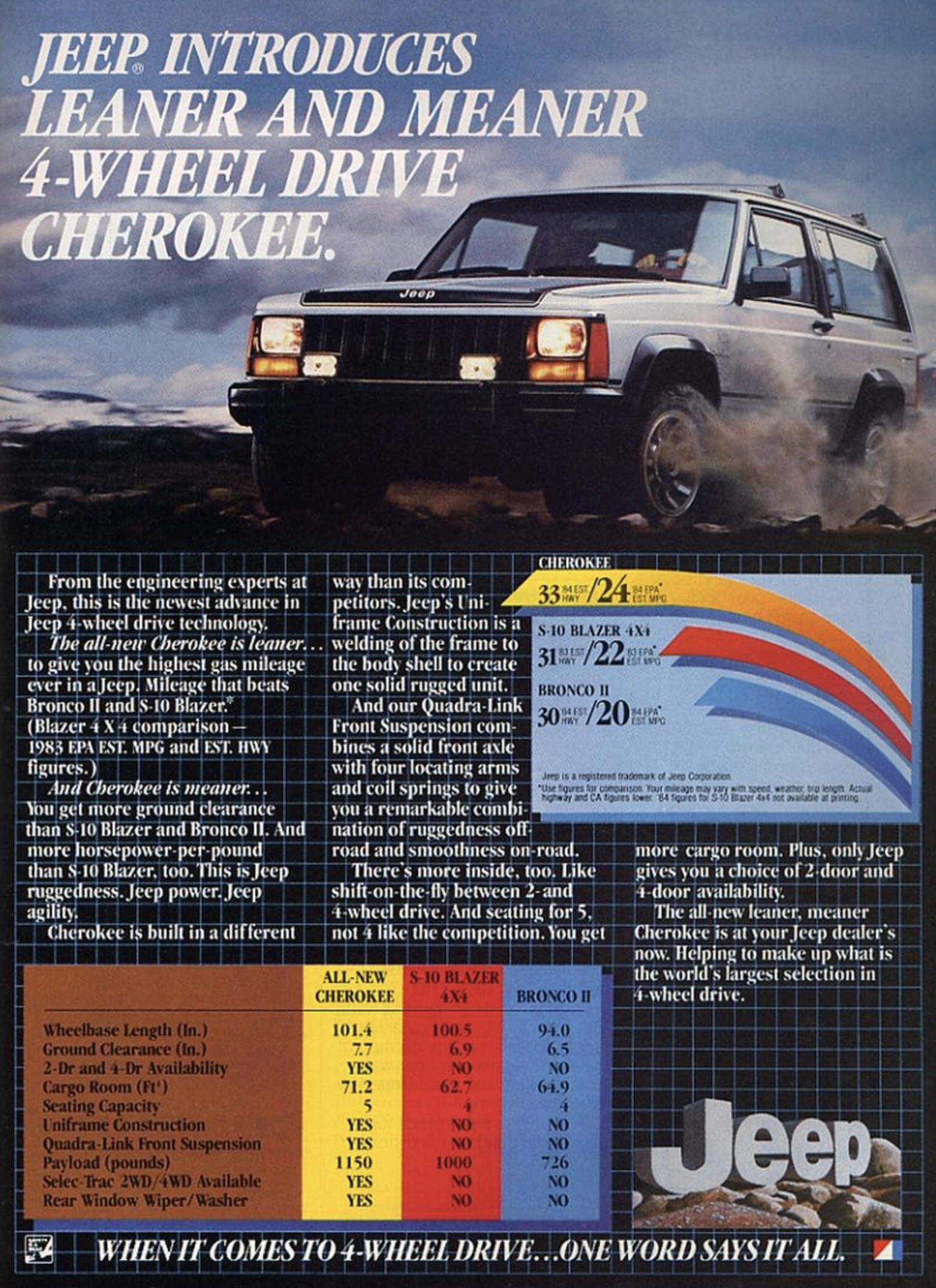
- oldcaradvertising.com: Jeep (1984)
- oldcarbrochures.org: AMC Eagle (1980); Jeep (1977)



Wow! This is a great article, and so is Ligo’s Article in Hagarty. From my memories of that era any non-German/Swedish cars were viewed with some skepticism at best, a miserable joke at worst. From what I recall the Brampton factory was pretty much ready to go. Most of the startup money was spent and it would give AMC a right sized car to sell that wasn’t a Renault. I don’t know how an alliance with BMW would work out but selling their products at each other’s dealers might have been a good match. BMWs later buying spree might have nabbed Jeep. I’m sure they would have been happier with than with Rover.
As an aside I find it fascinating that while Jeep is a cash cow, all the owners end up doing poorly. Bantam, Willys, Kaiser, AMC gone. Chrysler after being sucked dry by Cerebus ended up with Stellantis, which now seems to be the Sick Man of Europe.
The car produced at the Brampton plant was rolled out as the Eagle Premier after Chrysler bought AMC. Dodge was later given the Monaco, which was a badge-engineered version of the Premier.
It’s my understanding that the Premier was always intended to be sold as a Renault, as the plan was to retire the AMC badge completely.
BMW took over Rover because it allowed them to compete in the small car market and had Land Rover when BMW had nothing in that field. Jeep meant nothing in Europe. The tragedy for Rover is that BMW outbid Honda who understood Rover.
Recalling the Sterling debacle I am sure Honda knew Rover all too well.
It is sad that we are left to Monday morning quarterback corporate decisions without having the financials and binding documents in front of us. I don’t know how many of us have sat in front of a bankers committee asking for millions of dollars to keep a company alive. We think it is easy in hindsight. Chrysler was sucked dry first by Daimler-Benz, A.G. Steve Rattner selected the doofuses at Cerebus (John T. Snow, Dan Quayle and “Maximum” Bob Nardelli) to take the fall for the eventual failure of what was left of Chrysler and cash out the $80-million dowrey left by Dieter Zetsche.
I believe that that it was Cerberus that wanted out so badly and that Rattner’s decision was to find anyone that would take over Chrysler from them. Fiat was the only one that had an interest. So, Fiat or liquidation.
This article is hard to read for its general lack of any sense I would gather to say on Meyer’s part. Finding a French savior for ”American Motors” is idiocy at its finest.
This is no knock on a wonderful country – France – BUT at the time – the late 1970’s French cars were the running joke of the industry. Quirky – not in Americans design vocabulary – scanty dealer set up and suspect quality. So this is the man and his actions that saw a new day dawning for AMC – with its super Jeep line – and traded it for a crock of onion soup.
How did this happen?
“This article is hard to read for its general lack of any sense I would gather to say on Meyer’s part.”
Is your beef that there isn’t enough discussion of Meyers’ tenure as head of American Motors? If so, I covered him in greater detail here.
When you find that an Indie Auto article isn’t detailed enough, it could help to remember that our stories tend to run longer than most other car-buff websites. Even so, trade offs must inevitably be made: You can have more depth to individual stories or more frequent posts, but you can’t have both (unless you’d like to give me a big enough grant that I can hire additional writers).
Note that even when I repost stories, I still tend to spend a fair amount of time updating and often expanding them. Other websites typically rerun content with little or no changes. Their focus is apparently to make that cash register ring; mine is to advance automotive history.